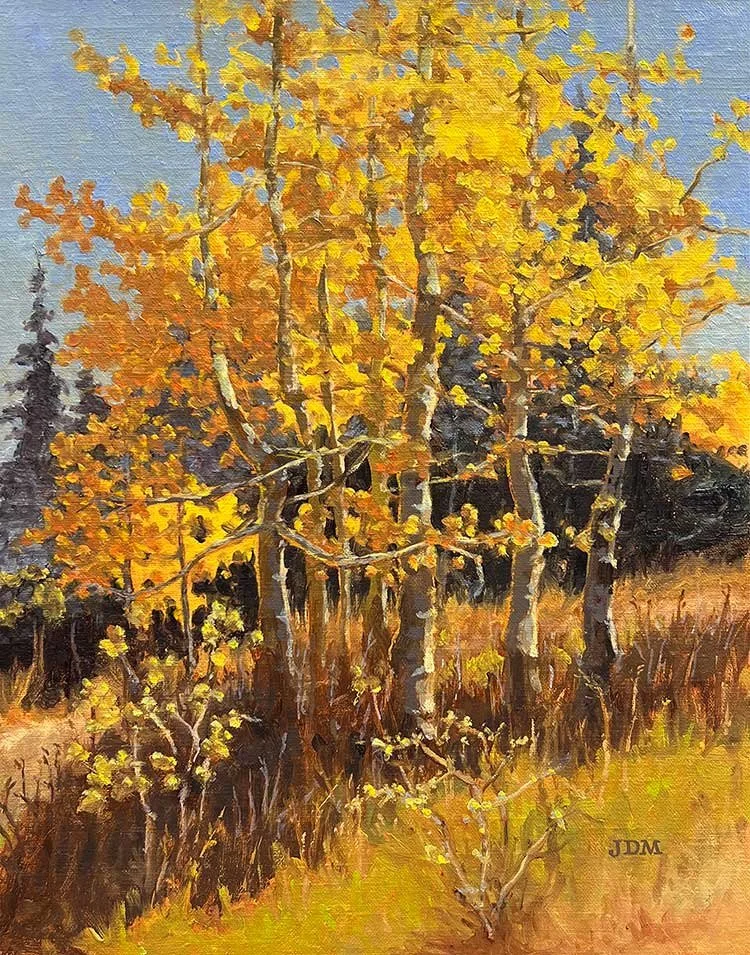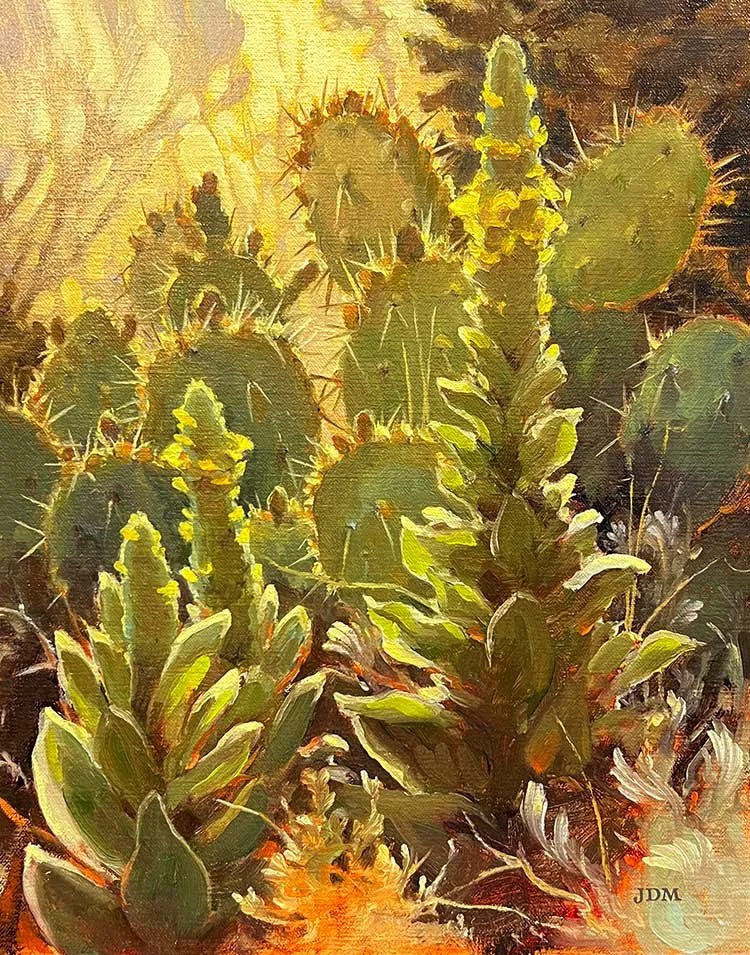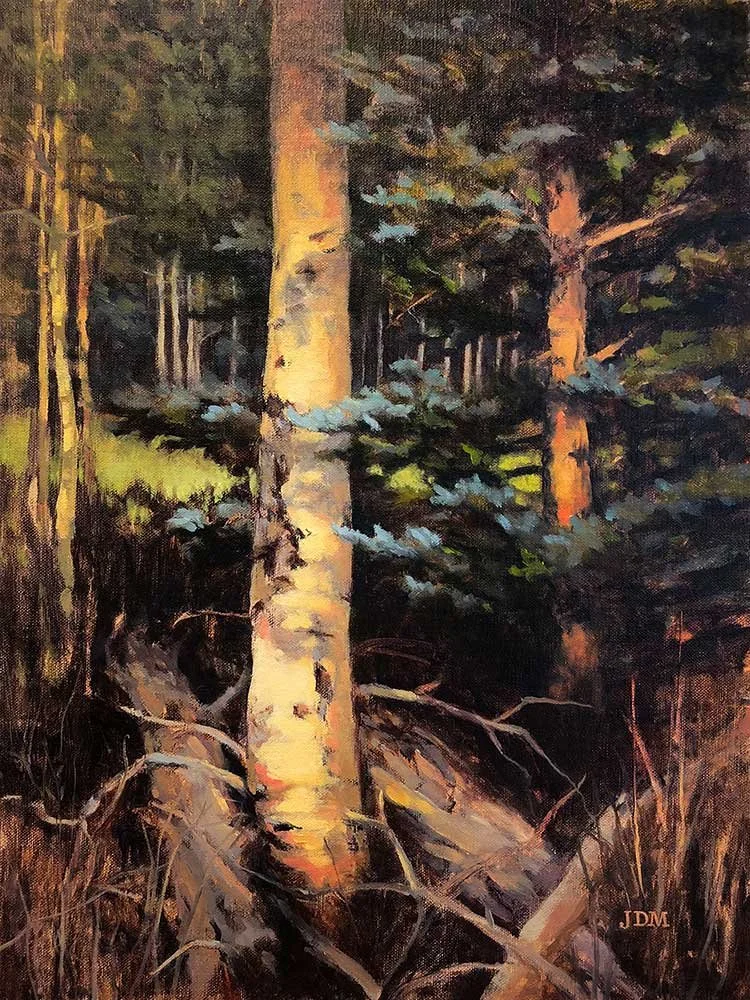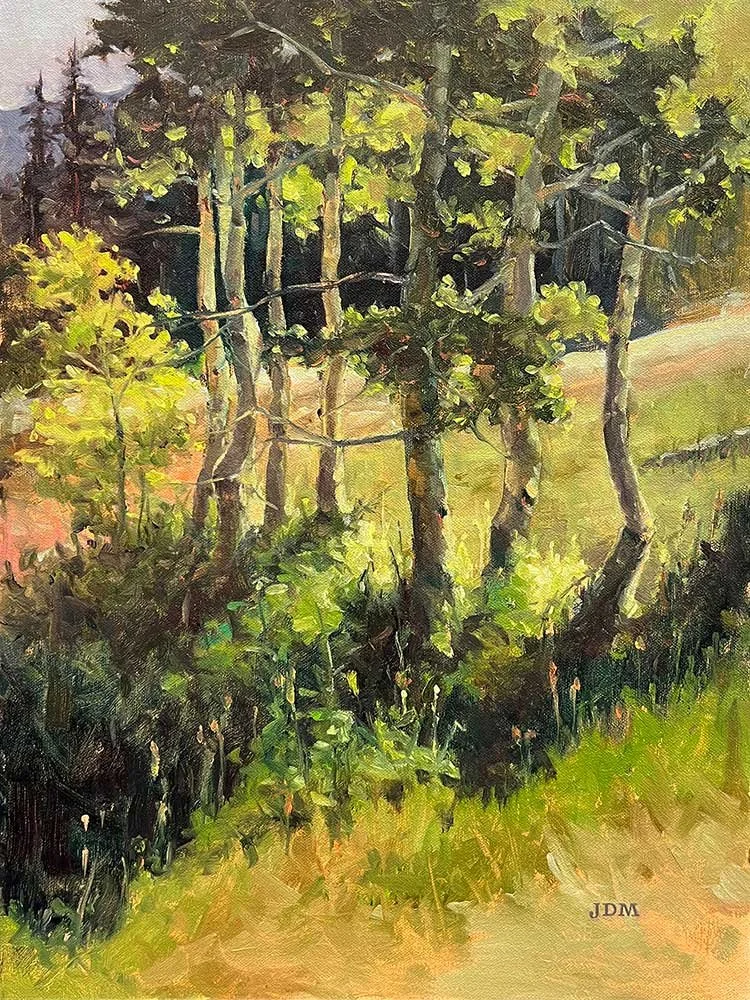
"Capturing the Natural World Through Plein Air Painting" with John Meister
Icebreaker: 5 p.m. May 23, 2027
Workshop: May 24 - 27, 2027
9 a.m. - 4 p.m.
4-Day Plein Air and Studio Workshop for painters who want to develop skills for painting outside.
$840 + 6.88% NM Sales Tax
About the Workshop
Skill level: Beginner and Up
Materials used: Oil and Water Mixable Oils
Painting outside is as much about learning to “see” as it is learning to “do”.
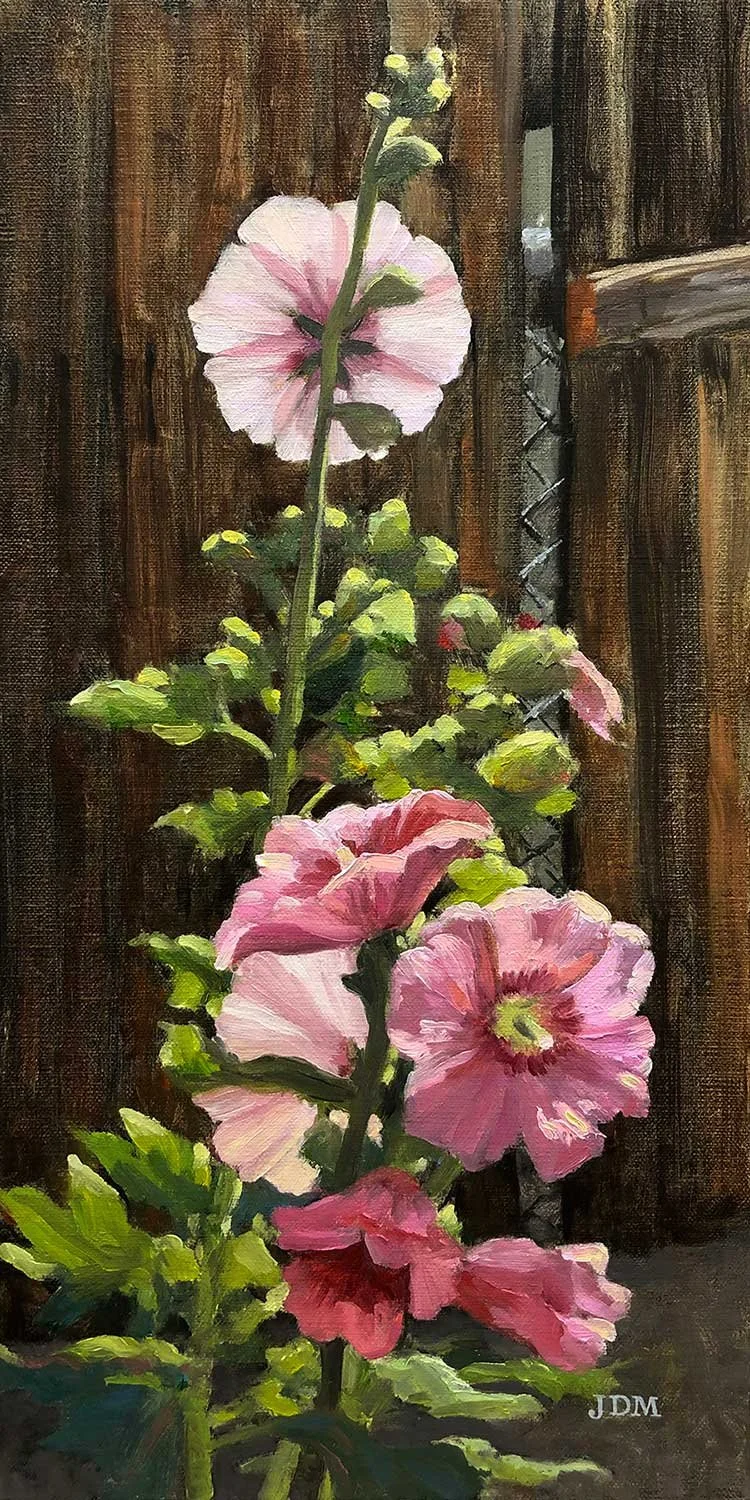
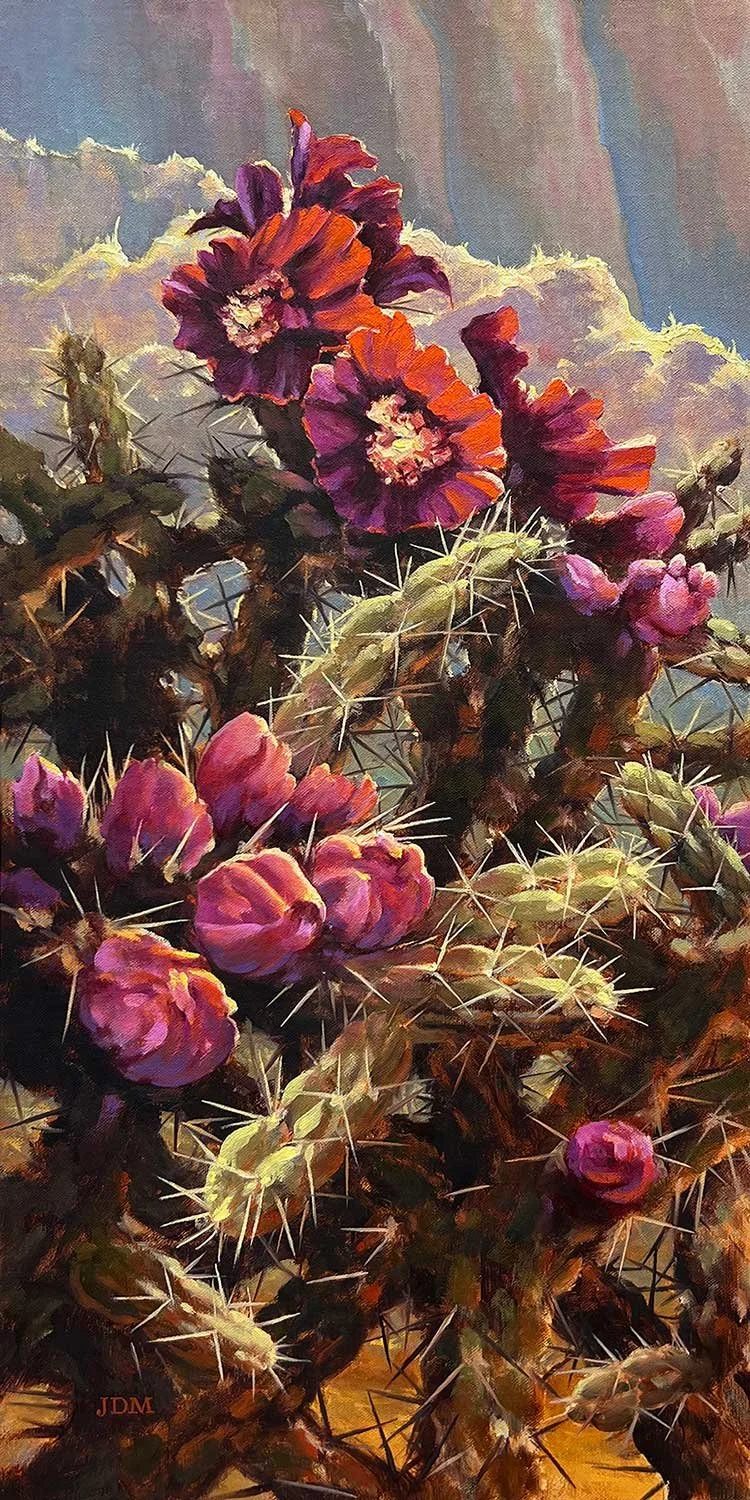
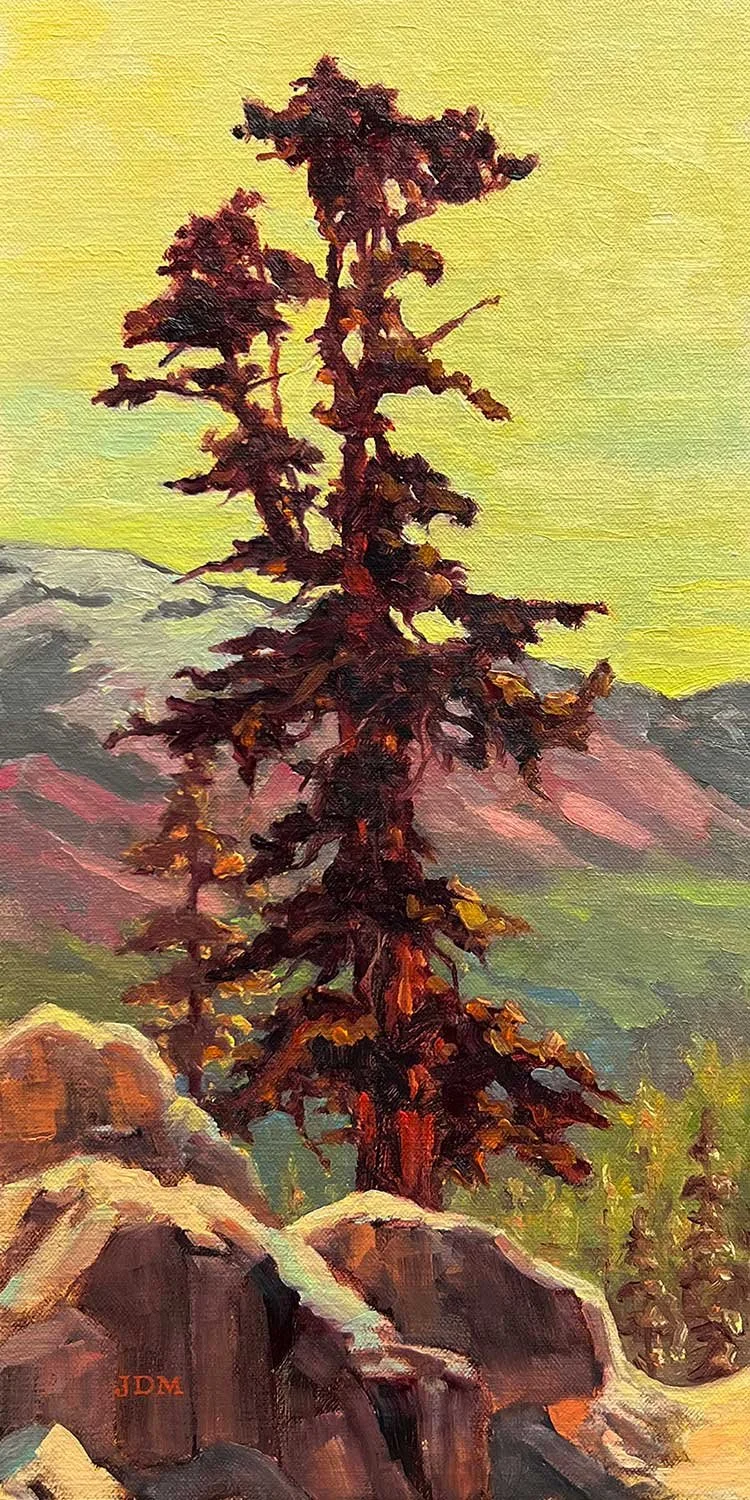
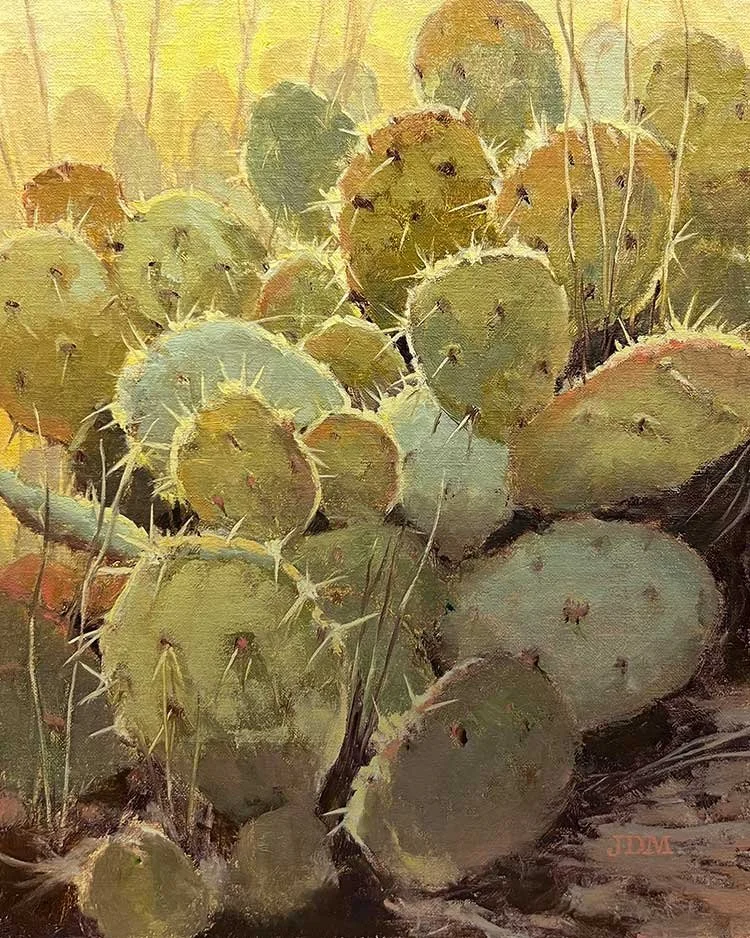
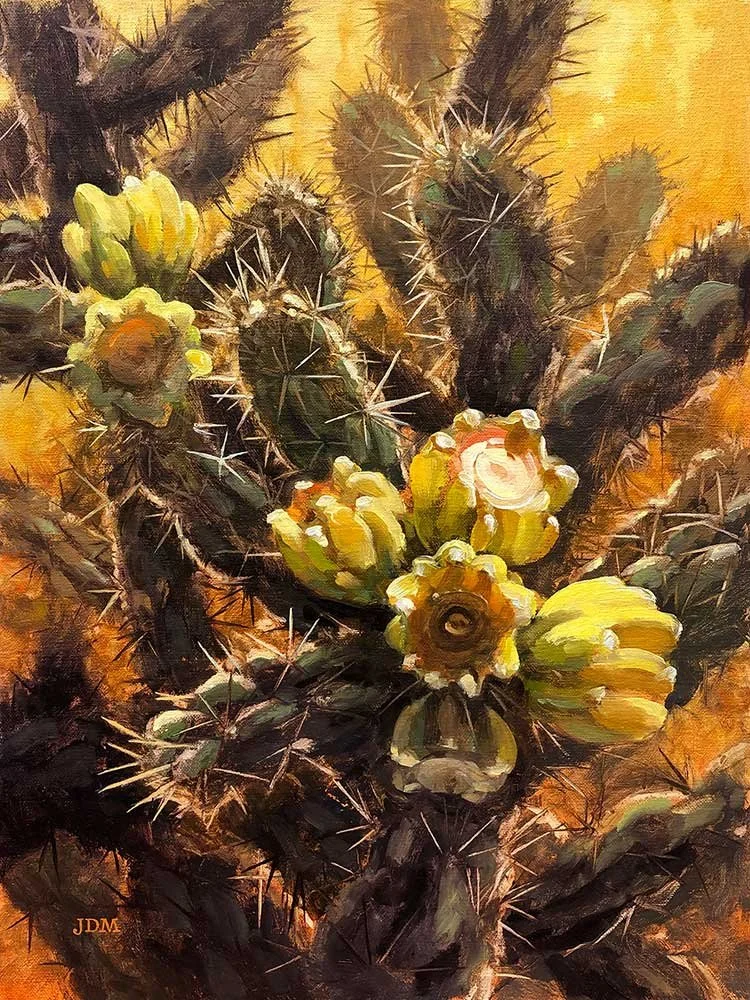
I consider myself a colorist and approach painting from the perspectives of light and color, especially when painting outside (in plein air). My predominate subjects are botanicals and landscapes with a more intimate view.
When I began painting full-time after a 23 year career as a graphic designer and illustrator I knew next to nothing about oil painting or marketing fine art. Although I took a few workshops early on, I am mostly self-taught and gained a lot of experience through trial and error (mostly error) and painting and critiquing with friends. I am an avid researcher of art tools and painting process and love reading about the history of pigments, paints and all “art things”.
There are many art instructors that are absolute masters of design, preparatory sketches, paint application, unique techniques, etc. This is all knowledge worth having and I know and will share some of it! I approach teaching by reflecting on my own practical journey as an artist – “What do I wish I had known when I began painting? What might make my paintings more successful now? Who seems to have tricks or wisdom that I don’t have? What do I still want to learn?”
This workshop is perfect for beginners and intermediate oil painters. It is also very applicable to more advanced artists and Rembrandt. I feel that every artist has something else to learn, and many seemingly small wisdoms can sometimes spawn a world of change to explore through art. My goal is not to create a bunch of “Mini Me” painters (that means you, Rembrandt) but to help you grow a little more into you.
We will paint both in the studio and outside (en plein air). I will provide a lot of new or forgotten tips, tidbits, and techniques that could change your life (maybe) or at least might make some things easier for you as a painter. I promise that you will come away with at least one technique or idea to implement – and I fully expect that I will learn something from you in the process. Hope to see you at Blue Bird!
Workshop requirements/supplies
Here is my list of supplies for regular use in the studio and plein air painting. You don’t need go out and buy every item on this list—bring what you’re comfortable with unless it’s otherwise noted with an asterisk*—this will give you a good idea of what I’ll be using in the workshop.
Sketchbook, Pencil(s), Pen
Great for notes during demos and thumbnail sketches before painting sessions. I am not in the habit of using a sketchbook before I paint (unfortunately). I tend to sketch/design on the canvas, relying on my design background and painting experience to guide me – warning: this can lead to fails, but I see fails as experience too! Many find preliminary sketches and/or “notans” to be very helpful in getting to a strong painting. They are especially helpful for those with less experience so that the layout is composed and there is one less thing to navigate while painting. I will demonstrate my process during the workshop.
Paint, Solvent and Mediums
Below is a list of the paints on my regular palette and the brands that I typically use. I don’t always use all of them but am use to having them at hand. I am not wrapped up with brands but I know exactly how the brands below mix/react/dry since I use them all of the time. I also sometimes use “guest” colors on my palette.
My first year of plein air painting I used four colors plus white. This greatly helped me learn to mix color. My second year I expanded to the colors with an asterisk below.
*I consider these with an asterisk (below) my minimum basic plein air palette, especially for botanical painting. Please bring at least this set of colors (brands are your option). Additional colors (on or off the list) are up to you.
I usually pre-mix “halftones” of my colors to save time especially when painting in plein air. We will discuss this shortcut in the workshop.
My Standard Palette:
*Titanium White (Gamblin) – A “cool” opaque White
*Maxima White (Gamblin) – This is a proprietary blend made only for Artisan’s of Santa Fe. It is a more transparent White and is good for mixing halftones of colors without neutralizing the color pigments. I will try to provide this color for each participant since it is only available in Santa Fe.
*Burnt Sienna (Windsor & Newton)
*Alizarin Crimson (Utrecht) – My “cool” Red
*Cadmium Red Light (Gamblin) – My “warm” Red
*Yellow Ochre (Utrecht)
*Cadmium Yellow Medium (Utrecht) – My “warm” Yellow
*Cadmium Yellow Lemon (Windsor & Newton) – My “cool” Yellow
*Sap Green (Windsor & Newton) – A “warm “ Green shortcut
*Veridian (Windsor & Newton) – A “cool” Green shortcut. Phthalo Green (Gamblin) may be used instead. It is stronger in pigment strength and usually requires taming down a bit.
*Cobalt Blue Pale or Hue (Holbein) – My “cool” Blue
*Ultramarine Blue (Utrecht) – My “warm” Blue
My Optional “Guest” Colors (You may have some others too):
Cadmium Orange Pure (Utrecht) – A permanent “guest” color on my palette
Cerulean Blue (Utrecht) – Some prefer this hue of blue for skies. A permanent “guest” color on my palette.
Dioxozine Purple (Utrecht) – A permanent “guest” color on my palette.
Quinacridone Magenta (Gamblin) – helpful for some flowers
Quinacridone Red (Gamblin) – helpful for some flowers
Paynes Gray Violet (Williamsburg) – A quick shortcut color that I use regularly. I will demonstrate how to mix this color from others.
Neutral Grays (Williamsburg or Gamblin) – Neutral Grays are another set of shortcut colors that are helpful for neutralizing color quickly. It is preferable to learn to mix them yourself before using shortcuts colors like these, but I use them all the time. We will discuss neutralizing color at length during the workshop.
*Gamsol Odorless Mineral Spirits (Gamblin) – Students must have this solvent. The Studio will have it to purchase in jars if you don’t have access to it locally or can’t travel with it.
*Solvent Can or Container – Preferably with gasket-type seal
*Gamblin Solvent-Free Gel (Gamblin) – Helpful in getting paint to a good flow state; stays wet on your palette for quite some time and doesn’t stick to it Also, you can transport it without issue in air travel since it’s solvent-free.
Feel free to bring any other mediums that you are comfortable using, especially if you are using Water-mixable Oil Paint.
Brushes and Application Tools
I use a variety of brushes in both bristle and synthetic. I am usually hard on them so I replace them regularly. Below are some of my personal preferred brands, shapes, and sizes, but I try many different brands too.
If you’ve already got a set of brushes you like, bring those. Make sure you have a decent mix of sizes and textures to work with!
*Bring at least a few NEW Filberts and Flat Brushes. Also, one larger or mop brush.
Bristle Brush Suggestions:
Rosemary
Ivory Short Flat (sizes 2, 4, 6, 8)
Princeton
Filbert (size 4)
Short Filbert (size 4)
Silver Bristlon
Filbert (sizes 0, 1, 2, 4)
Bright (sizes 00, 0, 1, 2, 4)
Synthetic Brush Suggestions:
Artisan Santa Fe
Filbert (sizes 2, 4, 6, 8)
Dynasty
Black Silver Filbert (sizes 8-12)
Black Silver Flat (sizes 8-16) – Larger of these are good for varnishing small paintings
Silver
Black Velvet Mop (sizes ½ or ¾”)
Brush Tip #1 (Kathleen Hudson): If you accidentally let paint dry on a brush, you can soak it for a few hours in Weber’s Turpenoid Natural and the paint will dissolve. You may need to repeat the process a time or two for larger brushes, but it works well...and doesn’t destroy the texture of the brush like some chemical paint strippers do.
Brush Tip #2 (Kathleen Hudson): Gojo hand cleaner makes a great brush cleaner. It gets all of the paint out— something Gamsol alone won’t do if you have paint lodged near the ferrule of the brush.
Palette Knife
Bring at least one around 1-3” long for mixing paint. Other sizes/shapes are optional.
Shaper Tools (optional)
Shape and type, your preference – They can be good for pushing or removing applied paint or carving thin lines in a painting (branches, power lines, etc.).
Panels and Substrates
I paint on panels when painting outside. The main reason is that they are durable and don’t let light from the back to shine through.
I paint almost exclusively on Raymar Oil-primed Linen Panels (C15DP). They are a little heavy due to the impregnated and bonded MDF board that they use. They do make some of their panels with 1/16” thick, Gatorfoam, or aluminum to make them lighter. I buy them in 5 packs to save a little money. There are plenty of other options as well, and most brands make multiple styles. This is probably the biggest price differential you’ll encounter in buying art supplies. You can bring the cheaper stuff for study and practice and use the pricier ones for your “significant” paintings. (I tend to always paint on the good stuff because there is nothing I hate more than getting a great painting on a really cheap less-archival surface – it’s less desirable to potential collectors.)
*Bring a variety of sizes: 6-7 panels for morning studio sessions (sizes 6x8” up to 11x14”) and at least 3 panels for your afternoon paintings (one per day) (sizes 8x10” up to 11x14”). You can bring a larger panel if you’d like help starting a studio piece to finish later. Feel free to bring a square size or other unusual dimension if you’d like.
*I will be demonstrating on oil-primed surfaces – for my technique, this is important. You are welcome to use acrylic-primed canvas or smooth panels, but I encourage you to pre-paint them with one coat of white oil paint and let it dry. This provides a slicker surface to work on. If you prefer to paint directly on acrylic primed canvas, that’s fine.
*I will provide a 12x16” Coroplast panel for each of you to tape your smaller panels or canvases onto.
Panel Suggestions:
Raymar Oil-primed linen panel C15DP or other (sizes 6x8” up to 11x14” – format up to you)
Sourcetek Oil-primed linen panel (sizes 6x8” up to 11x14” – format up to you)
Centurian OP DLX Oil-primed linen panels (sizes 6x8” up to 11x14” – format up to you)
Artefex, Da Vinci, others?
*Centurian OP DLX Oil-primed flexible linen Pad – 10 sheets (sizes 6x8” up to 11x14” – format up to you) This is an option but transportation of wet paintings needs to be considered.
Panel Carrier
These are handy. You can probably make do without one during the workshop if you have a clean pizza box or something, but if regularly you go plein air painting, these are helpful.
Panel Carrier Suggestions:
Ramar Plein Air Panel Carrier Lightweight corrugated plastic carriers that hold up to six thin panels (or three Gatorfoam ones) that share a dimension. (I.e., the 12 x 16 carrier can hold anything with a 12” edge up to 12 x 16”...so it would also hold 12 x 12”, 9 x 12”, and 6 x 12”.)
PanelPak Lightweight but sturdy wooden frames that hold two panels face-to-face (with 1/3 inch in between) using heavy duty rubber bands.
Easel, Palette, and/or Pochade Box
Each student will be provided with a table, chair, and easel for studio use. You will need to bring your own paint palette. Some students will choose to use their plein air easel in the studio since their palette is already incorporated with that.
*You will need to bring your own plein air Tripod and Palette or Pochade Box setup for when we paint outside. If it’s a new one, make sure you’ve set it up before! Some are tricky and you don’t want to spend class time trying to work around a new easel. Example: French-style easels can be difficult to set up if you’re not use to them. There are so many brands and styles to choose some – some made for portability (small and light weight) and others made for ruggedness in wind, etc. I have several different types that can be used inside or out. I prefer a more rugged style with a larger mixing area, but I pay for it when I have to carry it a long way to a painting site.
Lightweight Suggestion:
Daytripper (Joshua Been) – A three-part setup with a tripod, panel holder, and palette that gives good flexibility. With the right attachment it will hold a panel size up to 36” vertical. Very lightweight but can be a little unstable and flimsy, especially in wind.
Medium Weight Suggestion:
Sienna Plein Air pochade – they also sell an extra shelf that can be attached to the tripod legs below.
Other Items
*Please consider bringing the items on this list, especially those with an asterisk.
*1” White Pro Artist Tape – White papery tape available in most art supply stores
*View Catcher (viewcatcher.com) – A pocket-sized #5 neutral gray viewing tool to help artists frame compositions and judge value. Very useful in studio or outside. I will provide this for each participant.
*Razor Blade Paint Scraper – For cleaning you palette
*Camera – A smartphone is fine and can double as a pocket mirror. It’s good to record demos in progress, stages of your work, subject photos for later use, etc.
*Paper Towels – Blue shop towels, Viva, Bounty Select-a-size, etc.
*Trash Bag – For used towels. Reusable or plastic grocery bag is ok
Pencil and White Vinyl Eraser – For sketching out our composition before painting. This type of eraser is good at removing the graphite from the canvas.
Pocket Mirror – For checking your painting in reverse to see possible adjustments.
Rubber/Nitrile Gloves – If you like to paint with them
Umbrella – For painting outside (en plein air)
Wide-brimmed Sun Hat – For painting outside (en plein air)
Sun Screen
About John
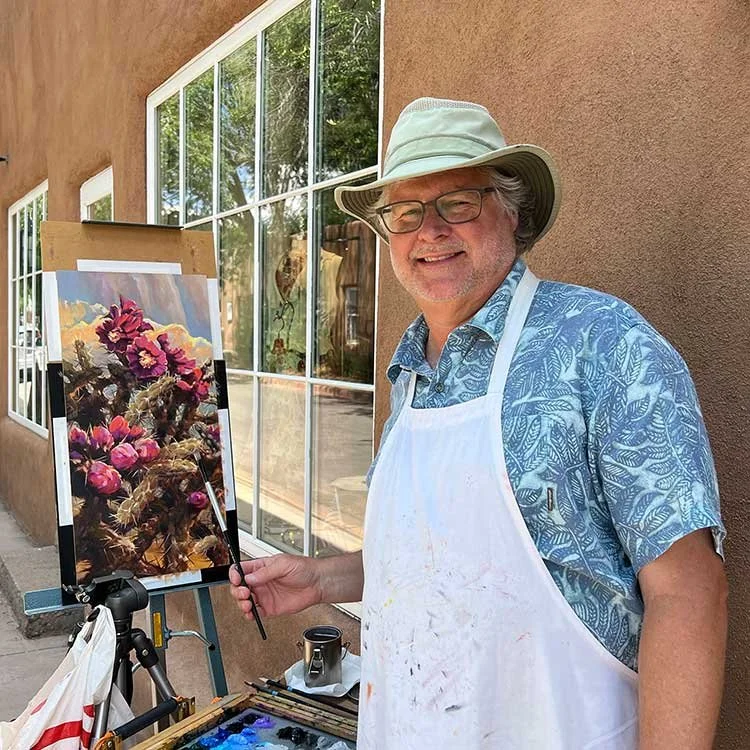
John Meister is known for capturing light and color in his paintings of unique aspects of the natural world. Rooted in 23 years of previous career experience in graphic design and illustration, he now splits his art production between his studio and painting in open air (en plein air), considering the New Mexico outdoors the perfect “classroom” for the artist.
“The term ‘magical realism’ had to be created for New Mexico. Living here, I appreciate the aesthetic of life in all its forms, and I gravitate toward intimate views of nature and the structure of things. Life must do a little something extra to thrive here, and sometimes it displays great beauty in the process. I strive to capture that.” –John Meister
Since the Fall of 2023, he has focused on a new style of work that places the viewer close to the subject, often a cactus, flower, or other botanical, in front of a simplified background of graphic color. Imagining these as performers before a backdrop, he evokes the days of the “Vaudeville” stage, intending with this work to show his appreciation of the natural form while providing an artistic answer to color and design.
John divides his time between Albuquerque and Santa Fe, NM. Sharing as an “art ambassador” to visitors and locals, he can occasionally be found demo-painting in front of Manitou Galleries (Santa Fe) where his art is represented. He is additionally now represented by Legacy Gallery (Scottsdale, AZ and Santa Fe).
GALLERIES
Legacy Gallery (Scottsdale) – 7178 Main St. – (480) 945-1113
Legacy Gallery (Santa Fe) – 225 Canyon Rd. – (505) 986-9833
Manitou Galleries (Santa Fe) – 123 W. Palace Ave. – (505) 986-0440
(John’s gallery artist page for all three galleries can be found at www.legacygallery.com)
MEMBERSHIPS & AFFILIATIONS
OPA (Oil Painters of America)
AIS (American Impressionist Society)
PAPNM (Plein Air Painters of New Mexico)
RGAA (Rio Grande Art Association)
NMAL (New Mexico Art League)
AABA (Albuquerque Art Business Association)
PRESS AND PRESENTATIONS
Western Art Collector (June, 2026) – John Meister – Land and Light
Western Art Collector (May, 2026) – State of the Art: New Mexico
American Art Collector (May, 2026) – The Art Lover’s Guide To Collecting Fine Art in Santa & Vicinity
American Art Collector (March, 2026) – Collector’s Focus: Art & Science
Western Art Collector (November, 2025) – Collector’s Focus: Western Small Works and Miniatures
Western Art Collector (May, 2025) – State of the Art: New Mexico
American Art Collector (May, 2025) – The Art Lover’s Guide To Collecting Fine Art in Santa & Vicinity
American Art Collector (March, 2025) – Collector’s Focus: Florals and Botanicals
Southwest Art Magazine (August/September, 2022) - Painted Stories, Group interview article for the Milagro Painters show at the Abiquiu Inn
Plein Air Magazine (April/May, 2022) Artist Guide to Plein Air Painting - PleinPainting Northern New Mexico’s High Desert, By John Meiste
Virtual presentation to the Rio Grande Art Association (November, 2020) - Tips for Tackling a Visually Complex Painting Subject, by John Meister
Plein Air Today (outdoorpainter.com) (April 2018) - Painting in New Mexico’s High Desert, A Land of Resilience in the Face of Decay, By John Meister
What’s included
This workshop includes a mix of complimentary food and beverages. Included are the following:
Complimentary continental breakfast: Yogurt, fruit, coffee, teas, juices, hard-boiled eggs, and pastries
Coffee, hot and/or iced tea, lemonade, soft drinks, sparkling waters, and fruit-infused still water are available all day
Catered lunch brought into the studio or painting location for $20 (optional)