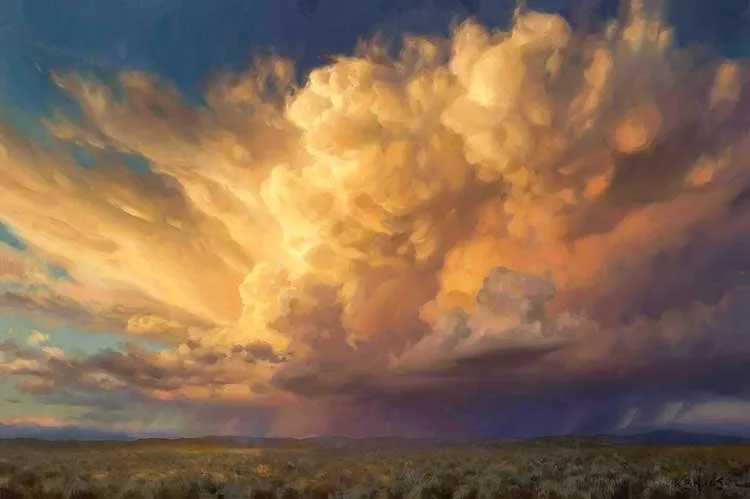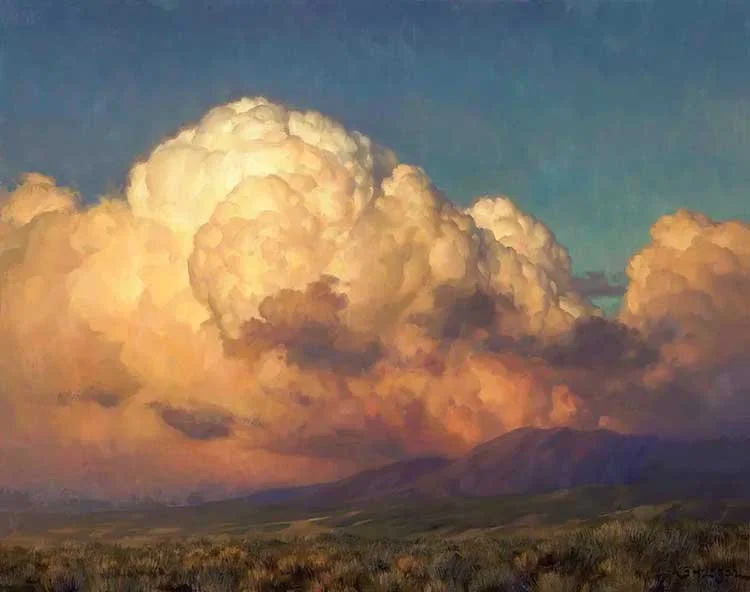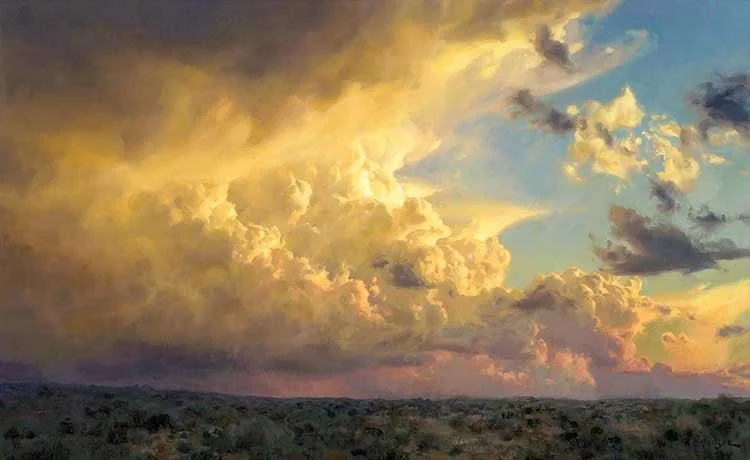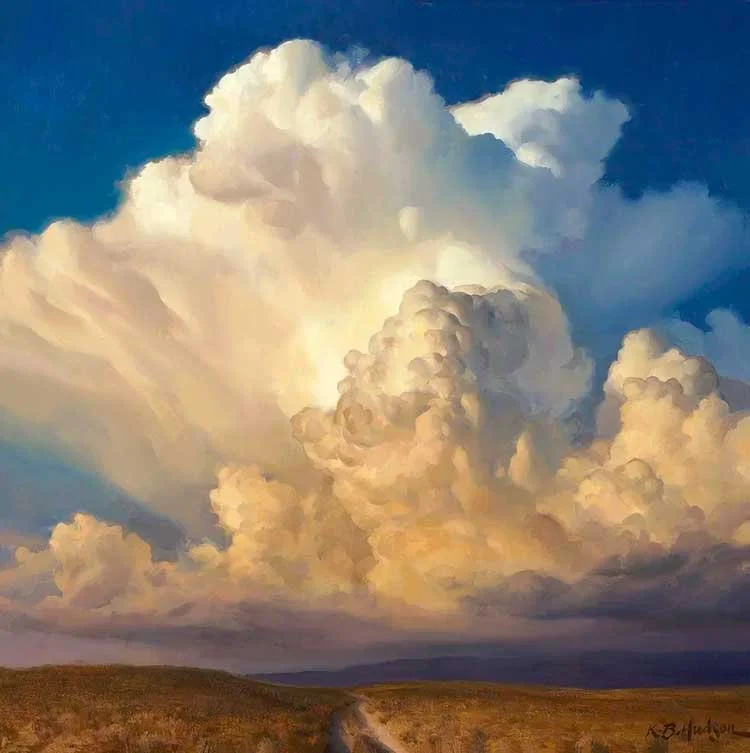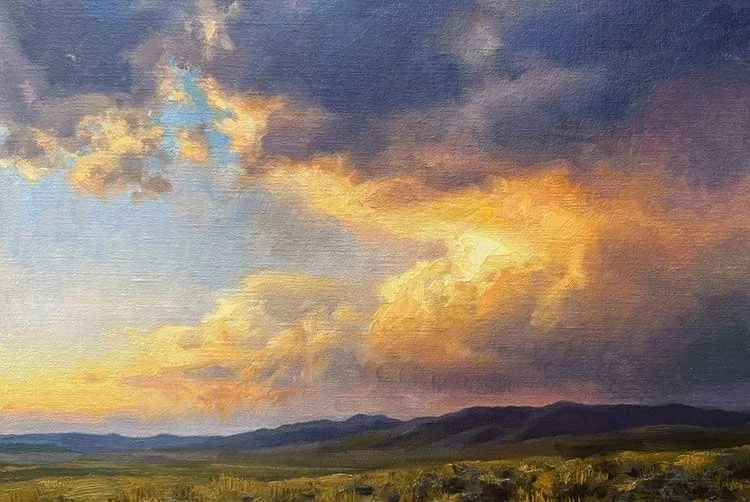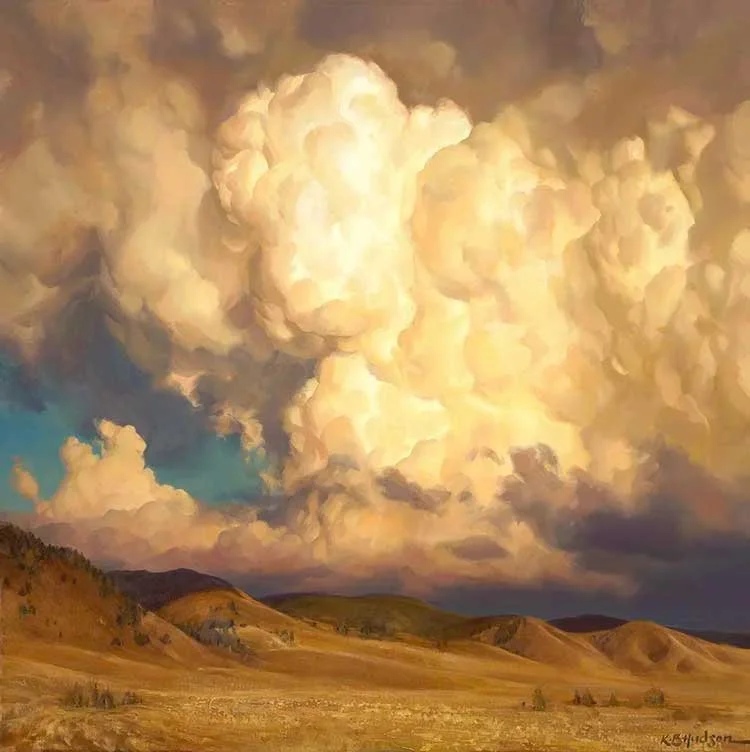
“Luminous Cloudscapes” with Kathleen Hudson
Icebreaker: 5 p.m. September 6, 2027
Workshop: September 7 - 9, 2027
9 a.m. - 4 p.m.
3 Day Studio Workshop
$750 + 6.88% NM Sales Tax
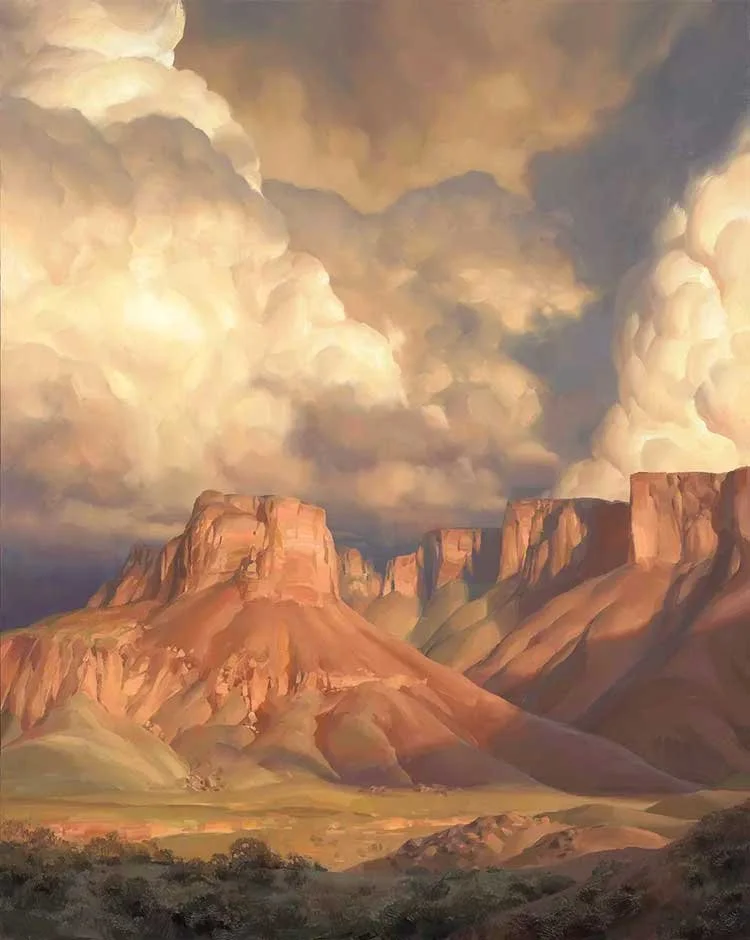
About the Workshop
Skill level: Beginner and Up
Materials used: Oil, Acrylic and Pastel
To follow
Workshop requirements/supplies
Following you’ll find a list of the supplies I’ve landed on for regular use in the studio and plein air painting. You don’t need go out and buy every item on this list—bring what you’re comfortable with, unless it’s otherwise noted—but this’ll give you a good idea of what I’ll be using in the workshop.
Sketchbook, pencil(s), pen
For notes during demos and thumbnail sketches before painting sessions.
Paint
I use Michael Harding oil paint (available here at Jerry’s). It has a wonderful pigment load and buttery consistency, so I can use the paint right out of the tube when plein air painting without having to thin it or use medium. Thanks to the pigment load in these paints, a little goes a long way! You may notice I prefer synthetic transparent colors that have a strong tinting power. I also like to have my palette stay wet for a while.
You can bring your favorite palette of pigments; below are the colors I’ll be using. The two colors on my list that aren’t on most people’s existing palettes are Indian Yellow and Magenta. I recommend giving these a try if you enjoy working with transparents.
Titanium White No. 1 (blended with safflower oil; slow-drying)
Cadmium Yellow Lemon
Indian Yellow (transparent, so it can be mixed without lightening deeper colors; fantastic for mixing greens)
Cadmium Red Light
Magenta (or Quinacridone Rose) – a great transparent tinting hue that is purer than Alizarin, which has some brown
Transparent Oxide Red (transparent; similar in hue to the opaque Burnt Sienna)
Yellow Ochre
Pthalocyanine Blue Lake
Ultramarine Blue
Cobalt Blue
Raw Umber
Ivory Black (sometimes...not always on my palette)
Neutral Gray (I love using pre-mixed grays to save time and help control my value range.)
You’ll note I don’t have any greens on my list. This isn’t because I oppose them—in fact, I often keep Phthalocyanine Green Lake, Emerald or Veronese, Michael Harding’s Green Gold, and Sap Green in the studio for convenience when I know I’ll be painting a lot of green. But I can mix all of these pretty easily, just as saturated, thanks to Phthalo Blue and Cadmium Lemon or Indian Yellow. It’s up to you if you want to have them on hand.
Mediums
Gamsol – students must have this; we can have extra on hand if you don’t have access to it locally or can’t travel with it. Other OMS brands aren’t really “odorless”. Let me know in advance if you’ll need some.
Gamblin Solvent-Free Gel – optional; stays wet on your palette for quite some time and doesn’t stick to it like glue like Liquin does when it dries. Also, you can transport it without issue in air travel since it’s solvent-free.
Brushes
I use Rosemary Brushes. They’re priced fairly given that their quality is well beyond most of what you can find on the market. You may save on international shipping charges if you order from one of their US retailers like Wind River Arts—but it’s worth checking to see if the markup makes it worthwhile. If you’ve already got a set of brushes you like, bring those. Make sure you have a decent mix of sizes and textures to work with!
I use:
Classic Long Flat – size 10 or 12 (for covering large areas; these are stiff and allow for scrubbing)
Ivory Long Flats or Ivory Long Flats ‘Curved Edge’ – sizes 6,8 (springy synthetic flats that keep their shape well; a little less stiff—but longer-lasting—than Silver Brush’s Bristlon flats)
Evergreen Longer Filberts – sizes 4,6,8 (Evergreen is the same synthetic bristle blend as Ivory, but dyed dark green in a process that actually softens the bristle a little. I like the extra softness in a filbert, but I prefer springier flats.)
Series 279 Master’s Choice Mongoose Long Flats – sizes 4,6,8 – these are ideal for softening edges or gently laying thick paint on a point of focus. If you thin your paint and have a light touch (like Jeremy Lipking, Susan Lyon, and Richard Schmid), a brush like this might be your favorite.
Series 278 Master’s Choice Mongoose Long Filberts – sizes 4,6,8 (optional; I like these for equine and figure painting but find I use the flats more often in landscape painting)
Mundy Goat Mops – sizes 3⁄4 inch, 1⁄2 inch, 3/8 inch – I’ve recently discovered these and they’re fantastic both for blocking in quickly with thinned paint and for smoothing edges at the end of a painting session. They can take a beating!
Ivory Dagger – size 3/8 inch (optional; these are fun and really encourage you to do interesting, calligraphic brushstrokes)
Ivory Egbert – size 6 or 8 (optional; also encourages some loose, fun brushwork)
Series 273 Master’s Choice Rigger – size 1 (optional; great for everything from thin tree branches to architectural lines to, well, ship’s rigging; mongoose has a lot of “give” but can be reshaped when wet, unlike stiffer synthetic blends)
Tip #1: if you accidentally let paint dry on a brush (we’ve all been there), you can soak it for a few hours in Weber’s Turpenoid Natural and the paint will dissolve. You may need to repeat the process a time or two for larger brushes, but it works well...and doesn’t destroy the texture of the brush like some chemical paint strippers do.
Tip #2: Gojo hand cleaner makes a great brush cleaner. It gets all of the paint out—something Gamsol alone won’t do if you have paint lodged near the ferrule of the brush.
Palette Knife
Bring one around 1-2” long for mixing paint.
Shaper Tool
Optional; great for taking out “mistake” brush strokes or carving thin lines in a painting (distant roads, power lines, rigging, etc.). Here’s one on Jerry’s and Amazon.
Panels
Bring a variety of sizes: 6-7 small panels ( between 4 x 6” to 8 x 10”) or some taped off larger panels for value studies. Bring three 8 x 10” to 12 x 16” for your afternoon paintings (one per day). You can bring a couple of larger panels if you’d like help starting a studio piece to finish later. Feel free to bring a square size or other unusual dimension if it fits the composition you have in mind.
There are a ton of options for painting panels, and this is the biggest price differential you’ll encounter in buying art supplies. (Yes, paint prices vary wildly, but for most artists, paint tubes last long enough that they’re less significant as a portion of the total supply budget.) I’d probably use New Tradition’s L600 or RayMar L64 exclusively if price were no object, but at $35+ for a midsize panel, that cost adds up quickly and can make me hesitant when painting...never a good thing! I use the more expensive stuff for larger studio work when I’ve put more time and research into a piece.
Centurion DP LX Oil Primed Linen Panels
As deeply inexpensive as these panels are, they’re a great substrate. If you typically use RayMar’s medium weave linens or other toothier surfaces, you may not like Centurion. But I use them often since I never worry about “wasting” them—and the double-primed linen covers quickly, which is great for plein air work. You can buy them from Jerry’s Artarama, but you’ll get about a 75% markdown if you become a member of Art Supply Wholesale ($99/per year) and order there. The other plus: as with more expensive surfaces, the double oil priming can be wiped down with a paper towel during the block-in stage to create highlights. You can’t do this on most affordable surfaces.
New Traditions
Their L600 is a joy to work on. It’s a smooth, oil-primed linen, available mounted on 3/16” Gatorfoam or on birch. They also carry different Claessens linens as does Sourcetek.
RayMar
RayMar’s L64 is a beautiful surface—it’s an Artfix Belgian linen that runs smoother than their other oil-primed fine weave linen (which I’ve found to require massive amounts of paint simply to cover the canvas!). Quang Ho uses the L64 from RayMar. The only downside to the RayMar panels (apart from price) is that the hard panel on which they mount linen is very heavy compared to Gatorfoam or MDF. This is an issue if you’re carrying them for plein air or packing them for travel. The new butterfly panel light option they have is truly lightweight, but hyper flexible to a point that I’d be nervous painting on it or trusting it inside a panel carrier.
DIY
You can cut MDF or hardwood panels to size and cover with an oil ground. If you like a really smooth surface, you can just seal it with Gamblin’s PVA size.
Panel Carrier
These are handy. You can probably make do without one during the workshop if you have a clean pizza box or something, but if regularly you go plein air painting, these are indispensable. I’ll lead with my personal favorite:
PanelPak
These are lightweight but sturdy wooden frames that can hold two wet paintings face-to-face (with 1/3 inch in between) using heavy duty rubber bands. You can get one for each of the standard sizes you frequently use. They are available in some common square and 1:2 ratio sizes if you like those, too. These take up very little space in your bag – just about a 1⁄2 inch beyond the panel size itself. If you like having a range of sizes on hand for studies and larger field paintings, they offer great flexibility.
RayMar
These are corrugated plastic carriers that hold up to six thin panels (or three Gatorfoam ones) that share a dimension. (I.e., the 12 x 16 carrier can hold anything with a 12” edge up to 12 x 16”...so it would also hold 12 x 12”, 9 x 12”, and 6 x 12”.) They’re bulkier and a bit less travel- friendly than the PanelPaks, but they’re handy if you do a lot of small studies...they have doublewide 6 x 8” carriers that hold up to 12 wet panels.
Easel
Most workshop venues have easels and plastic chairs for student use, although you’ll want to bring your own palette. You’re welcome to bring your own easel, but if it’s a new one, make sure you’ve set it up before! Some are tricky and you don’t want to spend class time trying to work around a new easel.
For plein air painting and in class demos, I use the Daytripper easel from Joshua Been. It’s a 2-part setup for a tripod that gives maximum flexibility in panel size (up to 36” vertical) and allows me to keep my palette lower, at the same height I do in the studio. At about 3lbs, it’s also lighter than most midsize pochade boxes.
Paper Towels
Any brand you like. I prefer the blue shop towels or Viva paper towels since I use fewer of them.
Bag(s) for used towels
I like using these nylon shoe bags from Amazon...they don’t rip inside my painting pack like flimsy plastic grocery bags are wont to do, and they’re reusable. But plastic grocery bags will certainly do in a pinch!
Camera
A smartphone should be fine for this, but it’s up to you! It’s good to record demos in progress, stages of your work, etc.
Pocket Mirror
For checking your painting in reverse to see possible adjustments.
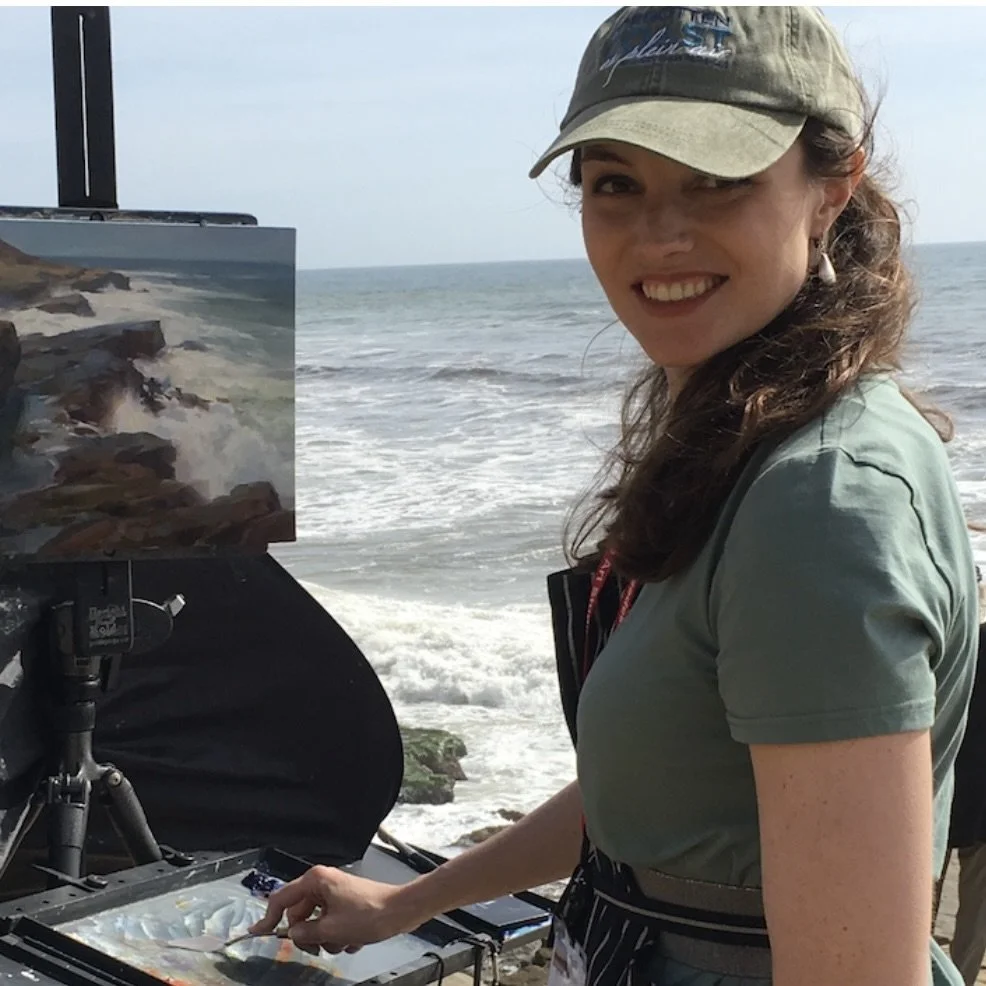
About Kathleen
Kathleen B. Hudson (b. 1986) emphasizes dynamic light and atmosphere in her paintings. She is a Signature Member of Plein Air Painters of America and the second youngest artist ever to be elected a Fellow in the American Society of Marine Artists. In 2017, Hudson received the Grand Prize in the 6th Annual PleinAir Salon for her painting Bright Morning, Timberline Falls, which was featured on the July 2017 cover of PleinAir Magazine.
Hudson moved from her native Kentucky to Boston in the fall of 2005 to begin an undergraduate degree at Harvard University. During her years in Boston, Hudson came to love the beautiful New England landscape as she painted, studied mountain travel narratives, and led backpacking trips for fellow students. After graduating with a History & Literature degree, she was selected to join Boston’s Copley Society of Art, the oldest non-profit art association in America.
Hudson now resides in Colorado Springs, CO with her husband and four children.
GALLERIES
McLarry Fine Art, Santa Fe, NM
FoR Fine Art, Whitefish, MT | Bigfork, MT
Broadmoor Galleries, Colorado Springs, CO
Edward Montgomery Fine Art, Carmel-By-the-Sea, CA
Huse Skelly Gallery, Newport Beach, CA
Cole Gallery, Edmonds, WA
MEMBERSHIPS & AFFILIATIONS
Signature Member, Plein Air Painters of America
Ambassador, Michael Harding Oil Paints
Signature Member, California Art Club
Signature Member, Laguna Plein Air Painters Association
Oil Painters of America
American Impressionist Society
PRESS
Art of the West Magazine. May/June 2025. Cover: Muir Woods. Feature: “Plein Air Ambassador,” by Clover Cameron.
Harvard Magazine. July/August 2024. Feature: “A Leading Plein Air Painter: Kathleen B Hudson ’09 captures the essence of the outdoors, from the Rocky Mountains to the beaches of Maui,” by Brandon Rosas.
Artist’s Magazine. May/June 2024. Cover: Wetlands Near Savannah. Feature: “Harnessing the Drama: Capturing dynamic changes in the landscape is Kathleen B. Hudson’s joy,” by Kristin Hoerth.
Southwest Art. December 2022/January 2023. Feature Article: “Moments of Rare Beauty,” by Bonnie Ganglehoff.
PleinAir Magazine, June/July 2017. Cover: Bright Morning, Timberline Falls
PleinAir Magazine, June/July 2018. Feature Article: "Presence of Place," by John Parks.
Southwest Art. Feature Article, July 2017: "Otherworldly beauty."
Keeneland Magazine, June 2018. Cover: Early Morning in the Bluegrass
Lexington Herald-Leader. "Lexington painter creates award-winning work the hard way." (July 28, 2017)
What’s included
This workshop includes a mix of complimentary food and beverages. Included are the following:
Complimentary continental breakfast: Yogurt, fruit, coffee, teas, juices, hard-boiled eggs, and pastries
Coffee, hot and/or iced tea, lemonade, soft drinks, sparkling waters, and fruit-infused still water are available all day
Catered lunch brought into the studio or painting location for $20 (optional)