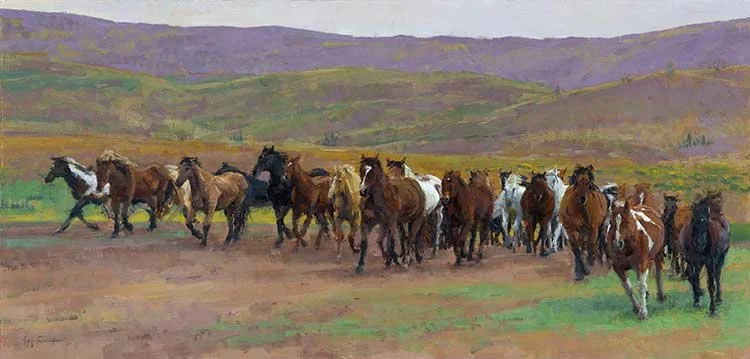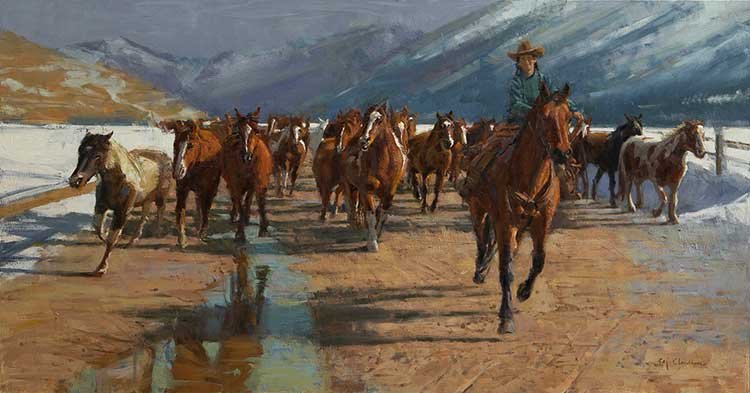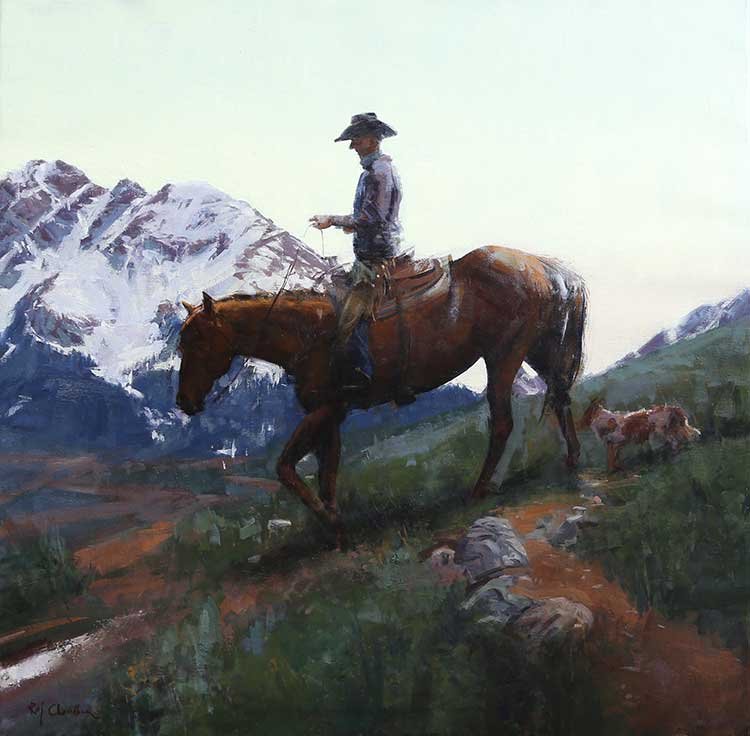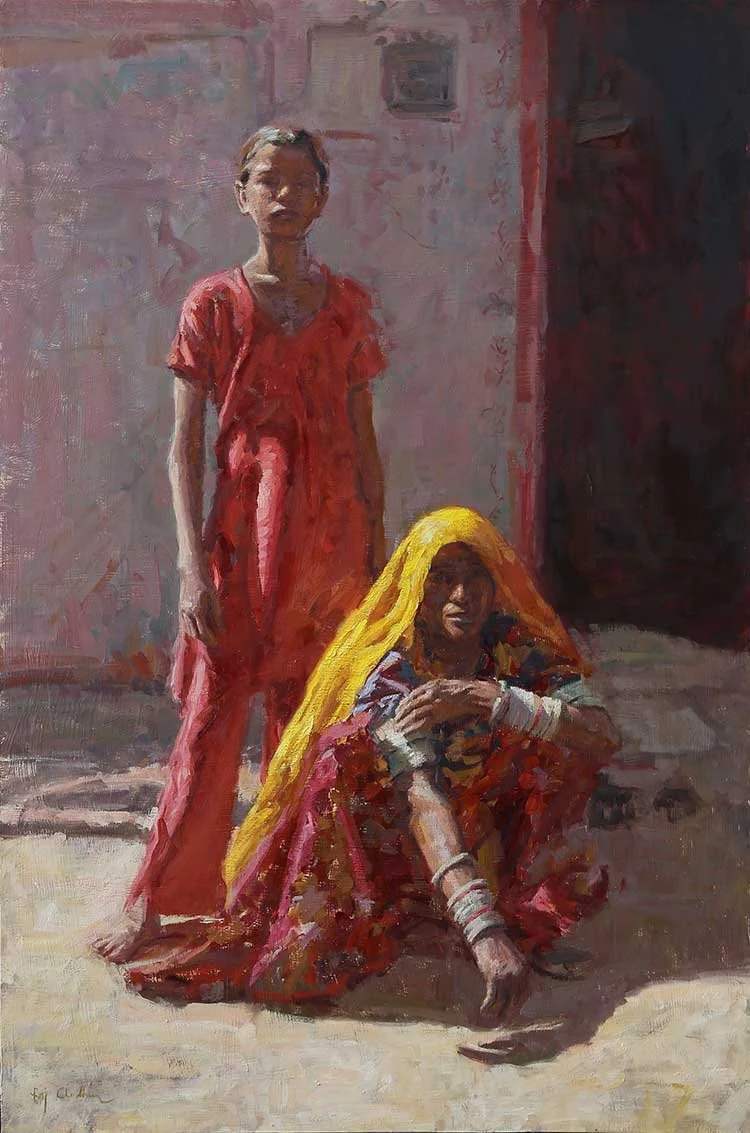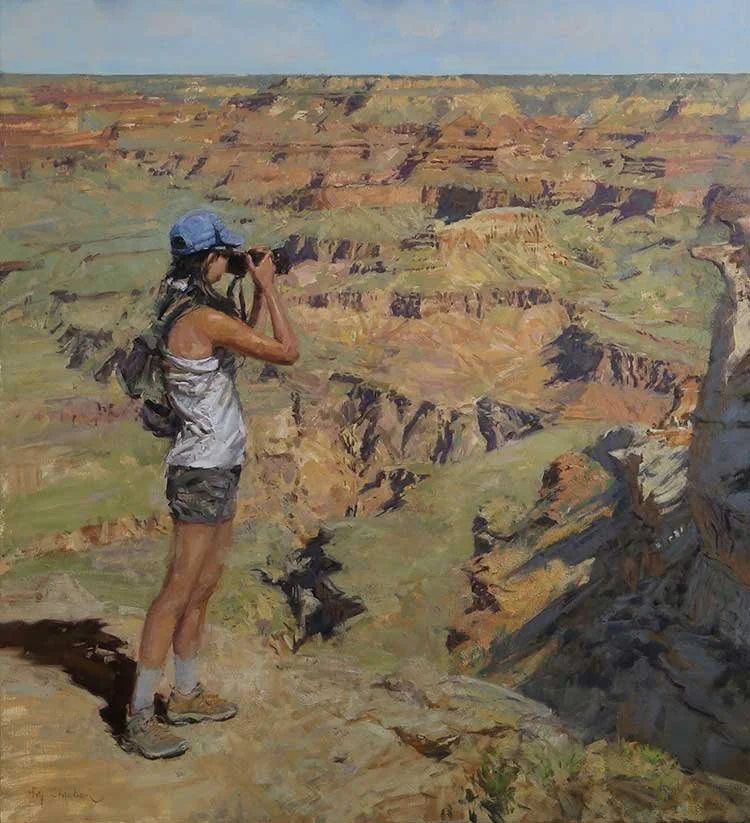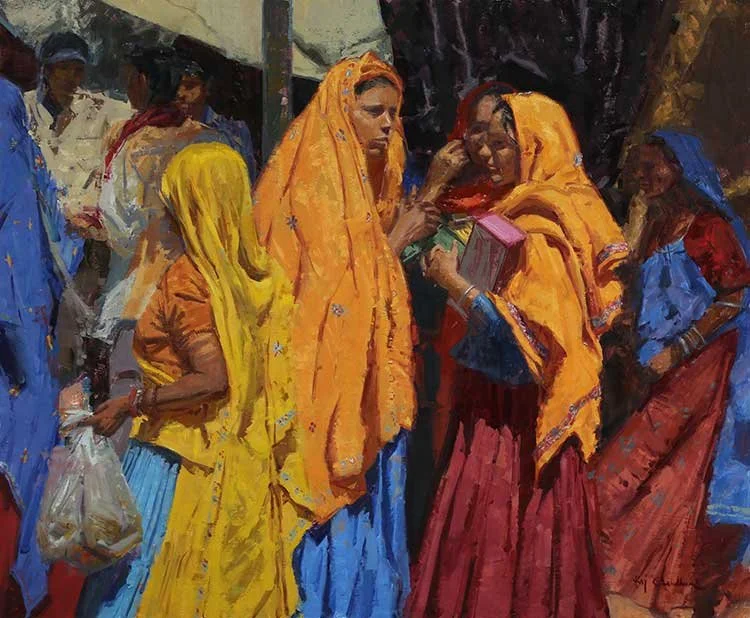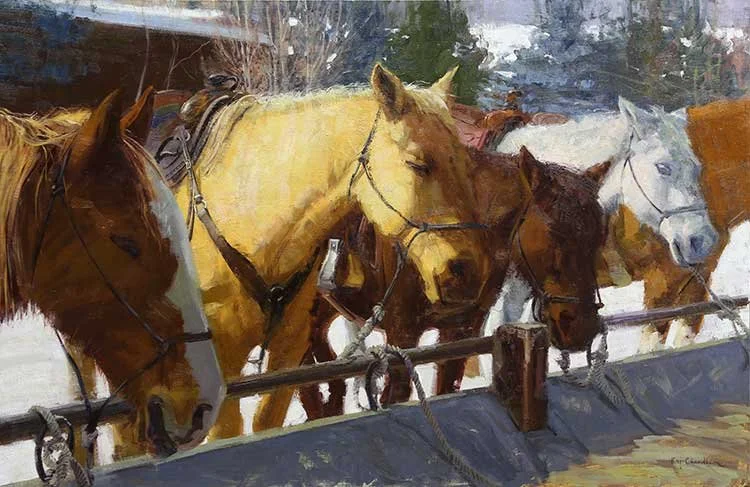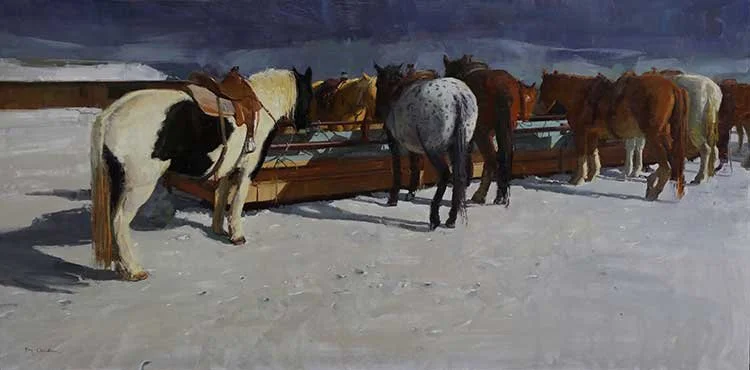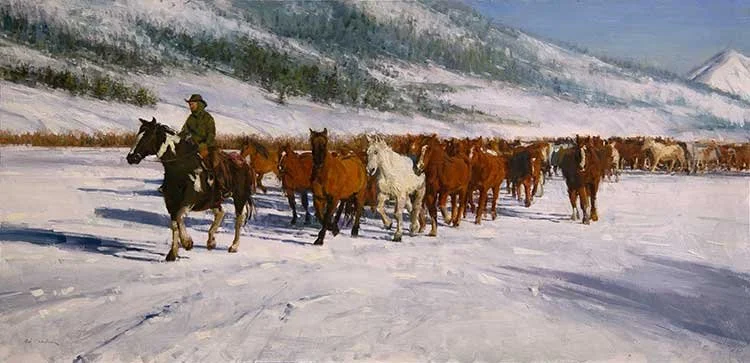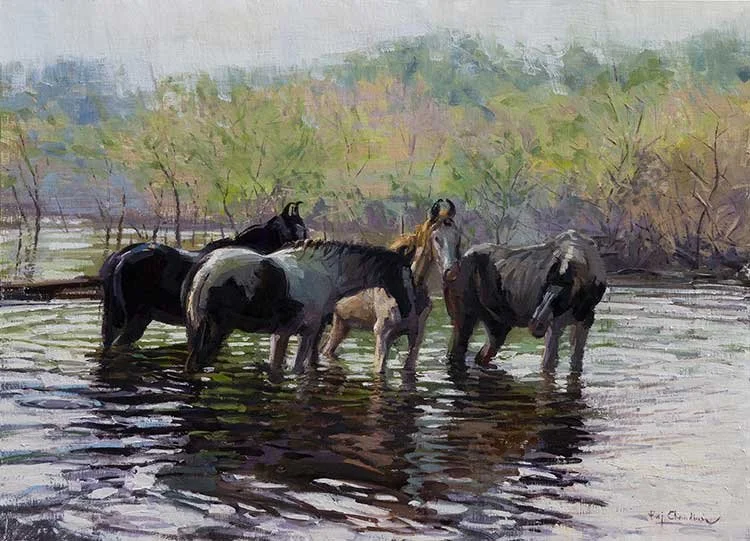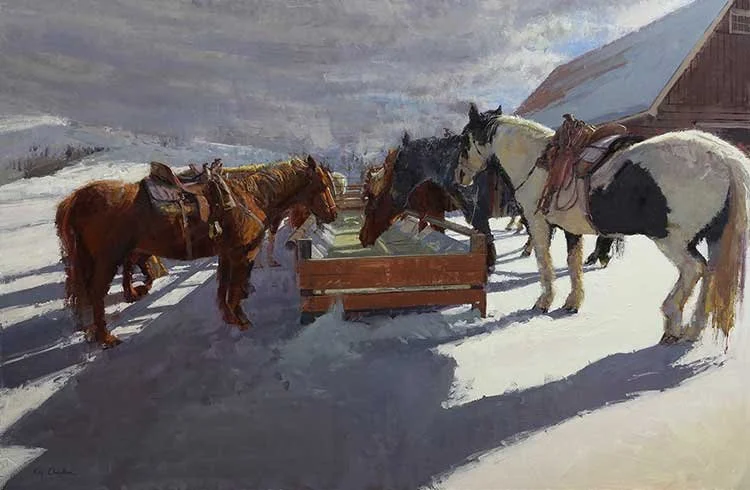
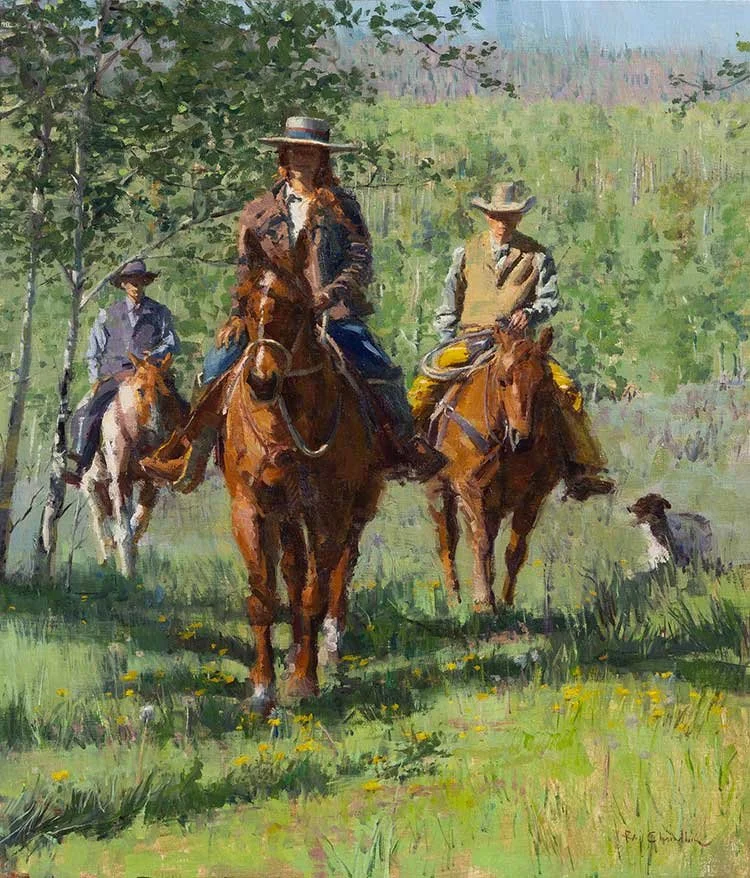
"The Process of Painting - Painting People and Horses in the Landscape" with Raj Chaudhuri
4 Day Studio and Plein Air (on Bluebird property)
Icebreaker: 5 p.m. September 14, 2027
Workshop: September 15 - 18, 2027
9 a.m. - 4 p.m.
$840 + 6.88% NM Sales Tax
Menu
About the Workshop
Skill level: Beginner and Up
Materials used: All mediums accepted. Teaching medium is oil.
Learn how to make successful paintings
This class will start with design considerations in a painting, then focus on separating value from color, to understanding color and its approaches, adding narrative elements, gradation of edges and many more topics. Here are four unique elements of my teaching are as follows:
Understanding the ‘Why’
Instead of giving more ‘rules’ that will tie creativity down in knots, or saying this is ‘easy’ or the ‘only way’ to do it, I will instead provide you with a deep understanding of the numerous complex parts of a painting. We will learn answers to many questions such as: what makes a good design? why is my color muddy? and more.
Simplify the process of painting into manageable parts
I believe that having a process to make paintings is paramount. Starting with notes and sketches for painting ideas, to studying historical and contemporary paintings, that hold your attention, to understanding what you love and want to paint. We will learn to use thumbnails for design, Photoshop to combine photographic images for the painting. Create color studies to provide a roadmap for the larger painting. Starting with a few (two or three) values and a full color palette to get the painting setup, introducing more values at a later stage. I will break down and simplify the painting process into manageable smaller steps so that you don’t need to make all the decisions at once. Painting is a very hard and elusive thing to do, but by focusing on the right things, to stop copying reference and having a plan to execute a good painting with curiosity and intent.
Two Value Start
I always start my paintings with only two or at most three values. This allows me to focus on the value separation between the light and dark or light and shadow shapes (dark and shadow are not necessarily the same!) and clearly see the design of the painting. Adding more values at a later stage is the correct way to develop the painting. So many more reasons for this which I will cover during the workshop.
Guided Demonstration
Finally, the guided demo is to me the most eLective and eLicient way to transfer knowledge dynamically. We will do several of these demo/paintings during the week-long workshop. I mix the colors, call out the combinations and pass along each mixture, allowing you to mix the same combination and match the value. Then we put down the paint on our paintings. This will improve color vocabulary, value control and drawing as we paint on each of our paintings together.
Painting Elements and Approaches
There are two parts to a painting, both of which are very important as an artist. First is the subject matter. We will learn how to make choices in a painting by answering questions such as ‘What is the Painting About?” The second part of the painting is all abstract and technical — it focuses on the Shape-Value-Color approach that I use in all my paintings. Painting Approaches from Light and Shadow to Local Tone to Dark Light Pattern will be discussed in detail and why they are important in the painting process. Learning to see beyond the reference or what’s in front of you to the why, will provide the tools to make better choices, to enjoy the painting process, make better paintings and grow as an artist.
Studio painting and Plein air Painting
We will do a lot of painting in this workshop. The medium does not matter to me, I use oils primarily but also paint in watercolor and do a lot of pen and ink / pencil drawing. You are welcome to bring whatever drawing/painting medium you would like to for the class. Our goal is to deepen your understanding of the painting process. Of course with oils, I will be able to show you many techniques to help you improve. Plein air painting has its own challenges but to me it is the best and honestly fastest way to improve! It forces one to make decisions and improve one’s ability as the light is constantly changing. I love plein air painting, so will have loads of tips and equipment choices that make it easier and more fun to do!
Ultimately, painting is about making choices, with intent, instead of being forced to copy reference. This applies to studio painting as well as plein air painting! Moving past the labeling of what you are painting, instead seeing the beauty of the design in front, will be freeing and let you learn more about your sense of beauty and develop as an artist.
Workshop requirements/supplies
Please bring the following items. I will bring some extra panels and brushes for the class.
Painting Panels
Please bring either an 8x10 or 9x12 panel to paint on. I’ll carry a 5x7 or similar size for you to try. I use these panels a lot: Centurion oil primed linen panel
https://www.jerrysartarama.com/centurion-deluxe-oil-primed-linen-canvas
Amazon carries a limited set of sizes of the Centurion panels
Please don’t buy the cheapest surface – try to get a double primed (oil or acrylic) medium or fine tooth (weave) panel. Cheap surfaces are not well primed with good (and very little) gesso and they are hard to paint on (and take more paint).
Paints
For the class please have the following colors (or close to it). I use mainly Gamblin Artist Colors and some Grumbacher Pre-Tested Artist Series. You can buy a cheaper line, such as Gamblins 1980 series or any other brand you’d like. The
important thing is to avoid ‘hues’ which approximate the actual pigment.
Gamblin Artist Colors
Titanium White
Quick Dry White
Cadmium Yellow
Cadmium Red Light
Alizarin Crimson Permanent
Yellow Ochre
Transparent Red Oxide (Grumbacher)
Viridian
Cobalt Blue
Ultramarine Blue
Additional colors on my palette (optional) for the class
Replacement Flake White
Naples Yellow
Cadmium Yellow Light
Cadmium Yellow Deep
Cadmium Red Medium
Napthol Red
Quinacridone Red
Gold Ochre
Terra Rosa (Grumbacher)
Sap Green
Phthalo Emerald
Cerulean Blue
Ivory Black
Brushes
For the workshop please bring a variety of brushes that you would normally use. Hard, soft, small and big brushes. I typically use hog hair bristle brushes, soft natural and synthetic brushes. These come in filberts, rounds and other types.
Here’s the list of most of the brushes I use …
Rosemary Brushes (https://www.rosemaryandco.com or https://windriverarts.com in the US)
** Ivory Series Long Flat and Filbert – 2-12
** Shiraz (short handle) – 0,1
** Eclipse – 2,4,5,6,8
Masters Series 278 Long Filbert – 2,4,5,6,8
Masters Series 279 Long Flat – 2,4,5,6
** These are my go to brushes! I would get a few of these to start with especially if your brushes are more than a few years old. Old brushes tend to dry up here and are very stiff – they will not work well unless taken care off.
Robert Simmons Signet Brushes
Filberts in Sizes 2,4,6,8,10
Egbert – 6
Robert Simmons Titanium Brushes — Rounds - 0,1
DaVinci Brushes (short handle) – Rounds – 0,1
Princeton
Misc (small) Round brushes such as the one below:
** Princeton Select Artiste Paintbrush 10-5 Brush set (on Amazon)
I’ll carry a few extra Princeton brushes for you to try in the workshop.
Paint Solvent
Gamblin Gamsol (turpentine substitute) for paint thinning
Palette
Typically a portable easel will have a palette to mix paint with. If you are bringing your portable easel (see easel’s section for
more) and it has a palette, that will work for the workshop. Otherwise please bring a palette that you like. Here’s a good one, you will need to add a thin piece of glass to it to make the use of it and cleaning easier.
In my studio, I use a big surface of glass (here’s a palette from Jerry’s that’s good). I would suggest putting some thin (1/4” or 1/8” glass inside it and use a window scraper to keep it clean.
https://www.jerrysartarama.com/masterson-air-tight-palettes-and-accessories
Brush Washer
For the studio, I use a larger size (but not too big). I prefer to replace the gamsol more regularly. For my travel (portable) setup I have a smaller one similar to this one shown below:
https://www.dickblick.com/items/anderson-sons-stainless-steel-airtight-brush-washer-8-oz/
Buy the size you want – there are many choices for brush washers but get an air tight one.
https://www.jerrysartarama.com/silicoil-brush-cleaner
Brush Care
After painting each day, I clean my brushes in solvent or use turpeniod natural (which is no longer available for sale in Colorado) or wash them in a sink with a good soap. I leave my brushes soaked in Safflower Oil (non-drying oil). My good friend and artist, Robin Cole has designed a wonderful brush tray that I use in my studio … here’s the link. You can also use a cheap tray from a hardware store.
https://www.robincole.art/store/savvy-brush-tray
Portable Easels
Here’s a list of some of the easels I am familiar with. You will need a portable easel for this class as we are painting outdoors for both days.
Prolific Painter Easel (Daytripper model, Salida, CO)
Z Box (Colorado Springs, CO)
Belly River Pochade
Open Box M (out of business)
Please search for any of these and their websites will come up. It becomes a matter of personal preference as they are all great boxes. You will need a tripod as well, which some of them offer, or look at B and H Photo Video (in NY). Please keep in mind to check the weight of the easel and get the tripod that is able to hold it (and not much heavier as the tripod itself can get very heavy if you are planning on doing Plein air work).
Panel Carrier for Wet Paintings
I use several Raymar Panel Carriers. They are wonderful! Please be sure to carry panels that fit in the panel carrier. For outdoor painting I usually use 8x10 and 8x16 panels. The 9x12 is a good option too, but if you are new to painting and and want to start small, an 8x10 panel carrier will be just fine. Here’s their website:
https://www.raymar.com/collections/wet-painting-carriers
Sun Shade
Painting outdoors I like to use this sun shade for laptops. I don’t like to carry an umbrella as they are cumbersome and a hazard when it gets windy. This too doesn’t work when its windy but doesn’t blow my easel away! I get this from Amazon.
About Raj
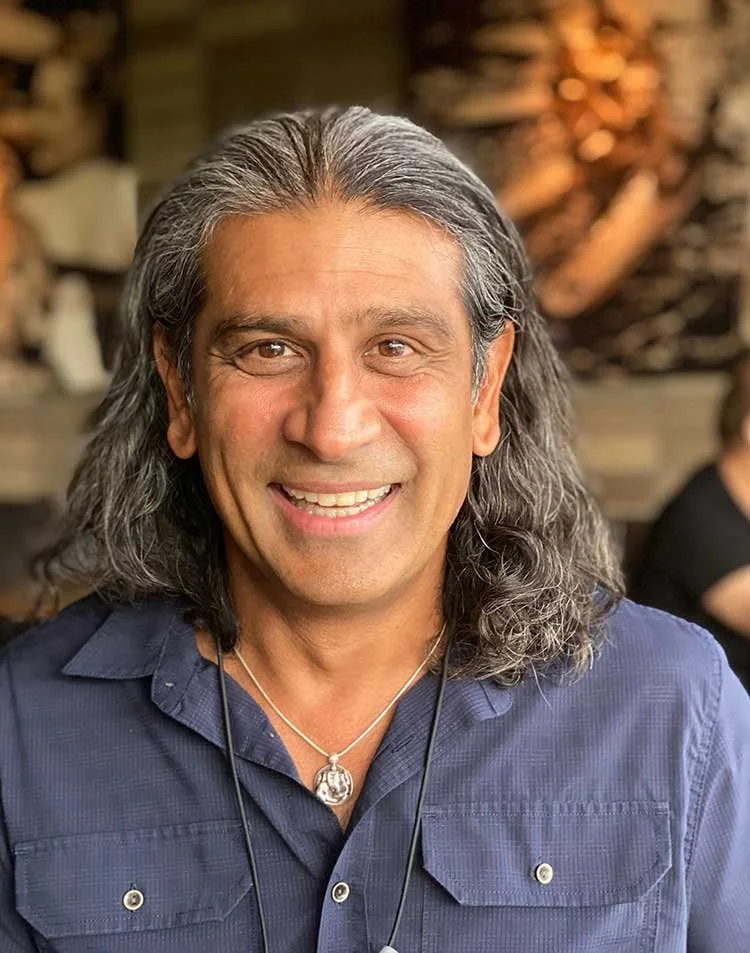
My work comes from my life as a human being. I paint what is around me, what I love and try to find beauty in it
My work comes from my life as a human being. I paint what I know and love. Capturing people and their interaction with the environment interests me—be it urban or rural, cityscape or landscape. I strive to find beauty in everyday happenings and how we experience this amazing world in which we live. Growing up in India, I feel my work is enriched by the depth of culture, vibrant colors and energy there. Twenty-seven years ago, Colorado became home, giving me a longstanding enjoyment of the mountains, the brilliance of people here and the rich history of the west. I truly enjoy traveling and painting on location; I thrive in painting subjects with which I have a deep connection and understanding of people, structures and landscape.
Art has always been my passion. I found ways to incorporate my artistic abilities in UI design and software development before coming to art full time. To a great extent I find that what like in computer design and now in art is that we are creating abstractions of the real world. There are repeating patterns in how we solve problems in many arenas. The creation of a painting is a technical and visionary problem, with many aspects behind the brushstrokes and values. These challenges underlie the thrill of creating a piece that speaks to viewers, to see what we feel and know about the world around us in art.
To me painting is about finding beauty, balance and something visually engaging. I am fascinated by how light illuminates my compositions. It is different literally in every painting! The design of a painting to me is paramount, and I try and find something beautiful, simple and clear in the composition and then build in layers upon layers of complexity. I want to lead the viewer through a visual journey and have them stay connected to the painting. Art is a way of
expressing something deeply personal along with the pure enjoyment of the visual. My goal is to find an interesting design clearly present in each painting, so the viewer sees the abstract visual dialogue that sets up the appealing story of the subject in the painting.
My wife and I have lived in Denver since 1998, where she started her medical career as a Physician. We have an amazing daughter who is a student at CU and is just thriving there.
In 2024 I was just thrilled to be awarded the Best in Show at the Coors Western Art Exhibition and Sale. It is an honor I will cherish forever.
What’s included
This workshop includes a mix of complimentary food and beverages. Included are the following:
Complimentary continental breakfast: Yogurt, fruit, coffee, teas, juices, hard-boiled eggs, and pastries
Coffee, hot and/or iced tea, lemonade, soft drinks, sparkling waters, and fruit-infused still water are available all day
Catered lunch brought into the studio or painting location for $20 (optional)